
Published
Studies
Peer-reviewed studies have demonstrated an association between infections, immune dysfunction, and the onset of neuropsychiatric symptoms. Additional studies highlight the clinical utility of the Autoimmune Brain Panel™ in identifying and guiding treatment for immune-mediated neuropsychiatric conditions.
Precision Testing Uncovers Autoimmune Basis for Seizures
A 14-year-old girl developed new-onset myoclonic seizures after traveling to the Caribbean, with reported exposure to ticks and sand fleas. Her initial episodes were characterized by brief, shock-like jerks affecting both the upper and lower extremities.
Serologic testing returned positive for Lyme disease, and EEG demonstrated generalized irregular spike-and-wave activity. However, her seizures persisted despite anti-seizure treatment. 1
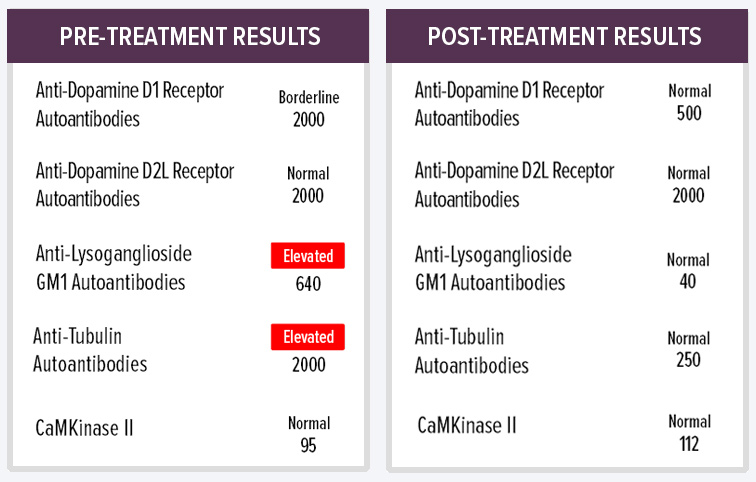
Given concern for an immune-mediated process, clinicians ordered the Autoimmune Brain Panel™. Results showed elevated anti-dopamine receptor D1 antibodies with borderline anti-Lysoganglioside GM1 and anti-tubulin antibodies ─ supporting an underlying autoimmune dysfunction.
The patient was treated with IV steroids, IVIG, and antimicrobials, which led to a complete resolution of her seizures.
After 2 weeks she was seizure-free. And at 6 months, she remained seizure-free without anti-seizure medications. 1
Misdiagnosed as Schizophrenia: An Infection-Triggered Immune Disorder
A 15-year-old female presented with sudden-onset neuropsychiatric symptoms, including “seizure-like” episodes, psychotic thinking, auditory hallucinations, catatonic movements, severe anxiety, and depression. 2
She was initially diagnosed with schizophrenia and required four inpatient hospitalizations. Despite standard psychiatric treatment, her symptoms did not improve.
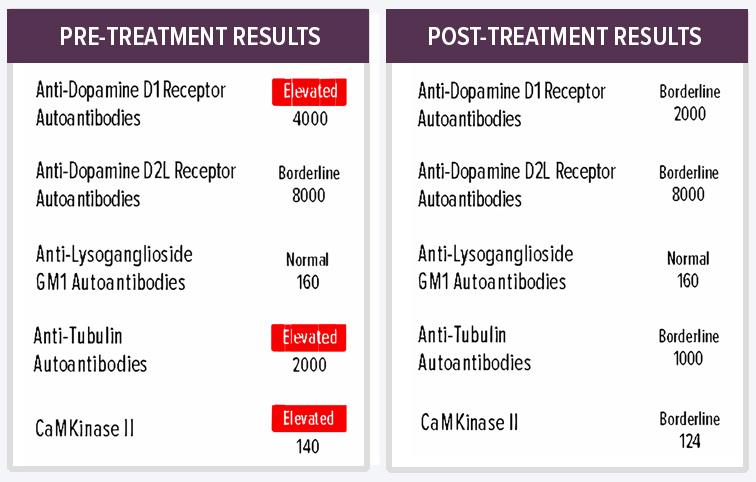
Testing with the Autoimmune Brain Panel™ showed elevations across all four anti-neuronal antibody assays, along with borderline CaMKinase II activation. Together, these findings supported an autoimmune basis for her symptoms.
Following treatment with plasmapheresis, the patient experienced complete resolution of her symptoms. And within two weeks of treatment, she discontinued anti-psychotic medication and resumed her normal daily activities, including playing tennis.
Autoimmune Brain Panel™ helps determine that symptoms were due to an underlying autoimmune process, rather than a primary psychiatric disorder.
Consultation for Utilization of the Panel
We provide free, medical education services to assist clinicians in better understanding the Autoimmune Brain Panel™ results.
Please complete this form, and a member of our team will contact you to schedule a consultation. Or, schedule directly through Calendly with Amy Cross, NP.
References
- Cipriano PM. Autoimmune Epilepsy Temporally Associated With Lyme Disease: A Report of Two Cases. Cureus. 2026 Mar 14;18(3):e105228. doi: 10.7759/cureus.105228. PMID: 41982592; PMCID: PMC13075592.
- Barzman, Drew H., Jackson, Hannah, Singh, Umesh, Griffey, Marcus, Sorter, Michael, Bernstein, Jonathan A., An Atypical Presentation of Pediatric Acute Neuropsychiatric Syndrome Responding to Plasmapheresis Treatment, Case Reports in Psychiatry, 2018, 8189067, 5 pages, 2018. https://doi.org/10.1155/2018/8189067
MORE PUBLISHED STUDIES

Intravenous immunoglobulin for the treatment of autoimmune encephalopathy in children with autism
Published: Translational Psychiatry
Study results suggest that the autoimmune targets in the Panel can predict IVIG treatment response in a subset of autism patients.

Case Report: PANDAS and Persistent Lyme Disease With Neuropsychiatric Symptoms: Treatment, Resolution, and Recovery
PUBLISHED: FRONTIERS IN PSYCHIATRY
A previously asymptomatic, healthy 7-year-old girl experienced an abrupt onset of several physical, neurological, and psychiatric symptoms increasing in intensity over a 3-week period.

Autoantibody biomarkers for basal ganglia encephalitis in Sydenham chorea and pediatric autoimmune neuropsychiatric disorder associated with streptococcal infections
PUBLISHED: FRONTIERS IN PSYCHIATRY
Study reviews the utilization of antineuronal antibodies, measured with the Autoimmune Brain Panel™ (formerly known as the Cunningham Panel™), as biomarkers for infection-triggered autoimmune basal ganglia encephalitis and the significance of the CaMKinase II.

Anti-lysoganglioside and other anti-neuronal autoantibodies in post-treatment Lyme Disease and Erythema Migrans after repeat infection
PUBLISHED: BRAIN, BEHAVIOR & IMMUNITY
The Autoimmune Brain Panel™ test results indicate Lyme disease may trigger an autoimmune dysfunction, as study findings indicate elevated neuronal autoantibodies may be associated with persistent symptoms.

Evaluation of the Panel in PANDAS and PANS: Changes in antineuronal antibody titers parallel changes in patient symptoms
PUBLISHED: JOURNAL OF NEUROIMMUNOLOGY
Study findings support clinical utility of the antineuronal and cell-stimulatory assays comprising the Autoimmune Brain Panel™ as an aid in the diagnosis of an underlying autoimmune etiology in patients with neuropsychiatric symptoms.