
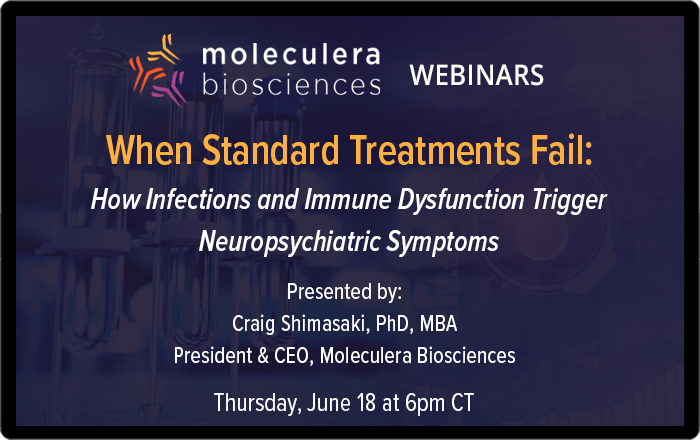
 Certain infections — including Streptococcus, Mycoplasma pneumoniae, Coxsackie virus and Lyme disease, can trigger an immune response in which antibodies mistakenly target neuronal structures within the basal ganglia, a region involved in movement, behavior, and emotional regulation.
This autoimmune response can disrupt neuronal signaling and promote inflammation, contributing to symptoms such as OCD-like behaviors, tics, anxiety, mood changes and attention difficulties.
These patients are often labeled treatment-resistant and mistakenly diagnosed with a primary psychiatric, neurologic or behavioral disorder. When, in fact, they have a treatable autoimmune condition.
Craig Shimasaki, PhD, MBA
 Craig Shimasaki is President and CEO of Moleculera Biosciences, a neuroimmunology precision medicine company focused on identifying underlying roots of neurologic, psychiatric, and behavioral disorders triggered by an autoimmune response. He is a medical research scientist with over 35 years of translational development experience in biochemical interactions, molecular biology, viral pathogenesis and infection-triggered neuropsychiatric disorders.
Dr. Shimasaki has worked at all stages of research and development from bench to bedside. His research included epitope mapping of HIV proteins, genetic based risk predictors of breast cancer, influenza and RSV diagnostics and therapeutics and pathogenesis of infection triggered neuropsychiatric disorders. As a businessperson, he co-founded multiple companies and led multiple products through the FDA approval process and is a co-inventor on multiple patents.
Dr. Shimasaki started his career at Genentech. He received his BS in Biochemistry from University of California at Davis, his PhD in Molecular Biology from the University of Tulsa, and his MBA from Northwestern University, Kellogg School of Business. He is an Adjunct Professor at the University of Oklahoma where he teaches biotechnology entrepreneurship. His passion is to help translate scientific and medical discoveries into acutely needed products so that more patients can live healthier lives.